In this article
An unfinished ebook is not a failure. It is a plan with too much scope.
An ebook lead magnet can still be a strong choice. It can also eat weeks and convert almost nobody. This teardown shows what the format does well, where it breaks, and how to decide before you write page two.
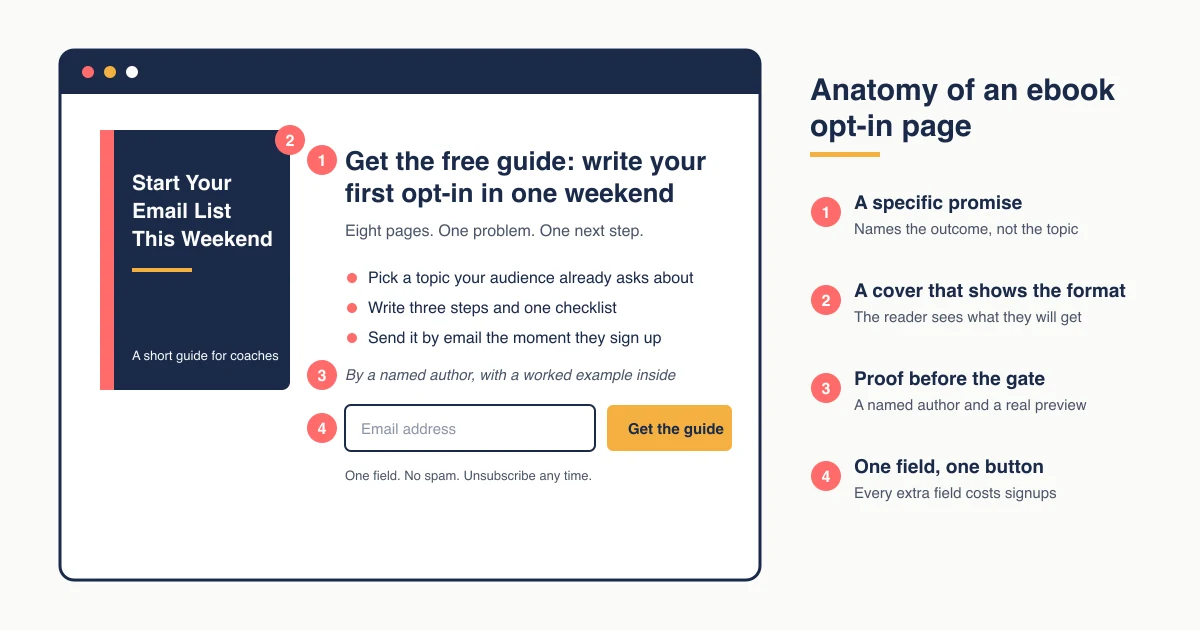
What Is an Ebook Lead Magnet?
An ebook lead magnet is a free guide, usually a short PDF, that a reader gets in exchange for an email address. It teaches one topic in more depth than a checklist or cheat sheet, so it suits complex subjects and warm audiences. It also takes longer to build, and that is where many creators stall.
This is a teardown, so it works from real pages. It reads two public ebook offer pages from HubSpot, lists what a solo creator can copy, and skips what only a large company needs. It then looks at where the format breaks, using research from Nielsen Norman Group on PDFs. It ends with a plain rule for when an ebook is worth building.
The short verdict comes first. An ebook works when the reader already trusts you, the topic needs depth, and you already have the material half written in posts, emails, or talks. It fails as a blank-page project aimed at a stranger who wants a quick win. For most creators with a small list, a checklist ships faster and gets used sooner. The checklist vs. ebook comparison settles that choice head to head. This page goes deeper on the ebook side.
One limit on the evidence. HubSpot is a large company with a large audience, so its pages teach structure, not scale. And no reliable public benchmark separates ebook opt-in rates from other formats. So this article makes no claim about a “typical” ebook conversion rate. Be wary of anyone who gives you one without a named source.
New to the basics? Start with what a lead magnet is, then come back.
What Can You Steal From Two Real Ebook Lead Magnet Pages?
HubSpot’s ebook and report pages sell the download before they show the form. Each one carries a format label, a one-line promise, and proof of what is inside. A solo creator can copy that order and drop the parts that serve a large company, such as long forms and partner consent text.
Both pages below were public when this teardown was written, and both sit behind an email form. Pages change, so read the details as a snapshot.
Page 1: The State of AI in Marketing
This page is labeled “Free Report.” Its one-line promise reads: “A global snapshot of how 1,700+ marketers are using AI to out-market their competitors.”
Before any form, it shows headline results from the survey. One example is HubSpot’s own figure that 98% of marketing teams use AI in some form. Then comes the form. The page says all fields are required, and a consent paragraph names three partner companies that also receive the data.
Steal: the format label, the one-line promise, and the preview of results. The visitor learns what they get and sees a taste of it before they pay with an email.
Skip: the multi-field form and the partner consent text. A creator building their own list needs one field and one clear promise.
Page 2: Master AI Agents in 2025
This page is labeled “Free Download.” Its promise names the authors: a “practical guide from HubSpot’s CMO and SVP of Marketing.” It then lists what the reader will learn: where to start, which applications deliver real value, and how to implement agents.
Steal: the named author and the concrete list of what is inside. Say who wrote it and why they can be trusted. Then say what the reader can do afterward.
Skip: phrases like “insider strategies.” They say little. Plain wording is more believable.
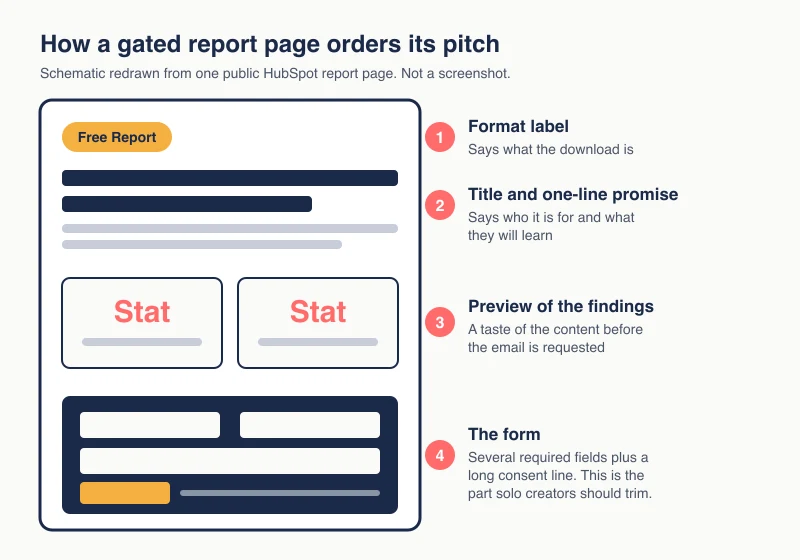
The pattern across both pages is the same: label, promise, proof, then form. Here is how it translates for a solo creator.
| Page element | What HubSpot does | Solo creator version |
|---|---|---|
| Format label | “Free Report” or “Free Download” | “Free 8-page guide” |
| Promise | Names the reader and the outcome | One sentence: who, what, result |
| Proof | Survey results or named authors | An excerpt, or one sample page |
| Authority | Named executives | Your name and one honest credential |
| Form | Several required fields plus partner consent | One email field |
The rest of the page matters too. The lead magnet landing page teardown breaks down the headline, bullets, and button.
Where Does an Ebook Lead Magnet Break Down?
An ebook lead magnet breaks down in two places: the build and the read. Broad topics grow until the project stalls. Then the reader meets a long PDF, and Nielsen Norman Group’s research found that participants often skipped PDFs or quickly abandoned them. A short, specific guide avoids both problems.
The Build Stalls
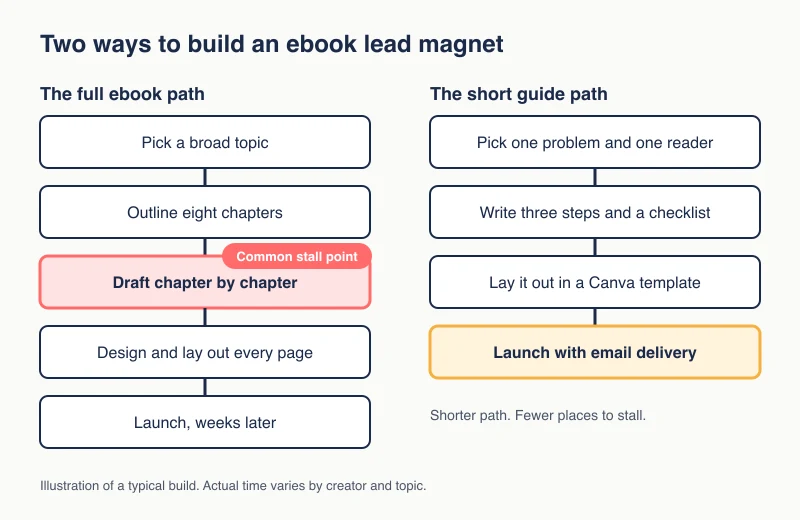
Ebooks start as a good idea and grow. A broad topic needs more chapters. More chapters need more research. The document sits open for weeks.
A checklist typically takes a few hours to build. A full ebook typically takes several weeks. Treat those as planning estimates, not measured data. The gap is the point: a longer build gives you more chances to quit.
The Read Is Hard
Nielsen Norman Group has studied how people deal with PDFs for years. Its article PDF: Still Unfit for Human Consumption, 20 Years Later lists problems that apply to a lead magnet file too.
PDFs are often “sized for paper, not screens,” which means tiny type and pinch-and-zoom on a phone. Many are “stuffed with fluff.” And long ones overwhelm people. One test participant said, “I was overwhelmed by the 41-page PDF of policy procedures.”
A fair caveat: those studies looked at PDFs on corporate sites and intranets, where people were hunting for an answer. A reader who chose to download your guide is more motivated. The lesson still holds. Length feels like work, and a file built for print is hard to read on a phone.
The Promise Is Vague
“The Complete Guide to Growing Your Audience” tells a stranger nothing. It does not say who it is for or what they will be able to do. A vague title fails the first test of an opt-in: can a stranger tell what is inside?
This is the deeper reason generic PDFs lose ground. The argument is laid out in why lead magnets are dead (and what replaced them). Narrow promises win. Broad ones get ignored.
Not sure which format fits your audience? The MagnetKit newsletter sends one format breakdown, one conversion tip, and one real example per email. Subscribe free
When Should You Build an Ebook Lead Magnet?
Build an ebook lead magnet when your reader already trusts you, the topic needs depth, and you have material to reuse. Skip it for a cold visitor who wants a quick win. Match the format to the reader’s time and trust, not to how impressive the file looks.
Use this table as a fast filter.
| Situation | Build an ebook? | Better first move |
|---|---|---|
| Warm audience that reads your posts or emails regularly | Yes | A short ebook |
| Topic needs an argument, a story, or a full method | Yes | An ebook or a mini course |
| You already have several related posts, emails, or talks | Yes, reuse them | Turn them into a guide |
| Cold traffic from social posts | Usually no | A one-page checklist |
| Service business that needs pre-qualified leads | Usually no | A scorecard or audit checklist |
| One free weekend and a blank page | No | A checklist or template |
Three signals say build it. Readers keep asking you the same deep question. You can assemble the guide from work you have already published. And the ebook is the first step toward a larger offer, such as a course or coaching, that needs trust to sell.
Two signals say skip it. You cannot say in one sentence what the reader can do after the last page. Or you are starting from nothing and your audience is cold.
If you are torn, look at the wider menu first. The freebie lead magnet guide covers twelve formats. For action-takers, a workbook often beats a read-only ebook.
How Do You Build a Short Ebook Lead Magnet That Ships?
Build the ebook around one problem, one reader, and one next step. Keep it short enough to read in one sitting, use large type, and add a one-page checklist so the reader can act right away. Then deliver it by email the moment they sign up and follow up.
Here are the steps that come out of the teardown.
- Write the promise first. Draft the title and one sentence: who it is for and what they will be able to do. If a stranger cannot repeat it back, narrow it.
- Cap the length. A good target is around 6 to 10 pages. That is a rule of thumb, not a study. Cut anything that does not serve the promise.
- Reuse what you have. Pull from blog posts, emails, or a talk. Tools like Designrr can convert posts into a draft, and the Designrr review covers what it does well. A blank page is the slowest route.
- Lay it out for screens. Use large body type, short paragraphs, and a page shape that works on a phone. This answers the “sized for paper” problem. The Canva walkthrough shows the layout steps.
- End with a checklist and one next step. A one-page checklist turns reading into action. The last page then points to a single offer or link.
- Deliver and follow up. Send the file in the first email, then send one related message a day or two later. The delivery email guide and the follow-up emails guide cover both.
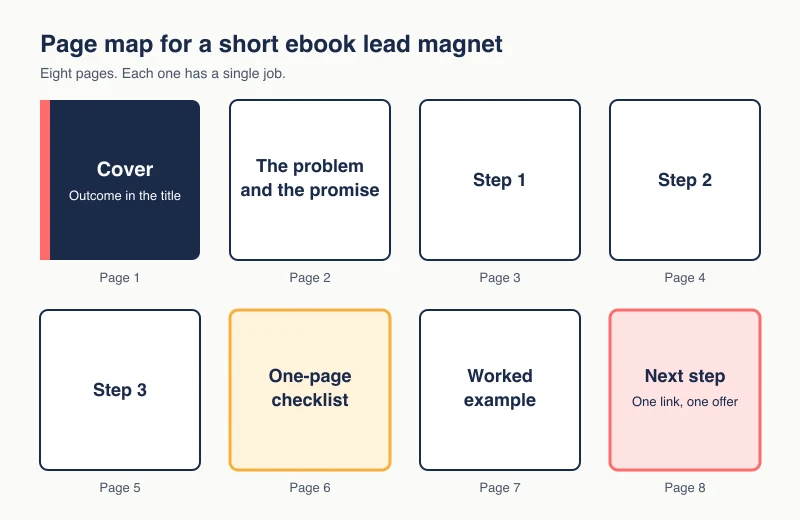
The page map above is one workable shape. Eight pages, each with one job. Change the count to fit your topic, but keep the rule: every page earns its place.
The verdict, then. The ebook is not a bad lead magnet. A big, vague, blank-page ebook is. Build the short one, aimed at people who already trust you, and you keep the strengths of the format without the stall.
Frequently Asked Questions
What is an ebook lead magnet?
An ebook lead magnet is a free guide, usually a short PDF, that someone downloads in exchange for their email address. It covers one topic in more depth than a checklist. It works best for warm audiences and complex topics, and it takes more time to build than smaller formats.
How long should an ebook lead magnet be?
Long enough to solve one problem and short enough to read in one sitting. A rule of thumb is around 6 to 10 pages. Longer files raise build time and the odds that readers quit, and Nielsen Norman Group flags long, fluffy PDFs as a common reason people give up.
Do ebook lead magnets still work?
Yes, when they are narrow and useful. HubSpot still gates ebooks and reports behind email forms, per its public resource pages. But a broad ebook aimed at cold traffic often loses to a smaller format. No public benchmark isolates ebook conversion from other formats, so test your own.
Should I put my ebook behind an email form?
Yes, if your goal is to grow your list. The exchange of an email for a useful guide is what makes it a lead magnet. An ungated ebook can build reach and trust, but it will not add subscribers unless you ask for the email somewhere else.
Can I turn blog posts into an ebook lead magnet?
Yes. Pick a handful of related posts that answer one question, then edit them into a single guide with a clear promise, a checklist, and a next step. This is often the fastest route, because you start with material instead of a blank page.
Keep Reading
What to Do Next
Choose the path that fits where you are right now.
Pick Your Lead Magnet Format Before You Build.
Get the free three-page Decision Matrix PDF. Match your audience to a lead magnet format, with a format quick reference to help you start building.
Get the Decision MatrixRelated Articles
Checklist vs Ebook Lead Magnet: Which One Converts?
Checklist or ebook lead magnet? Honest comparison by effort, conversion, and fit, with a clear recommendation for most creators.
Email Opt-In Message: How to Write One People Say Yes To
Write an email opt-in message step by step: headline, promise, button, consent line, thank-you page, and confirmation email, with copy to adapt.
What Is a Lead Magnet? Definition and How to Build One
A lead magnet is a free resource you trade for an email address. See how it works, which formats to pick, and how to build your first one this weekend.